A portal does not mean a transition to another world.
It is not a gate one passes through, nor a place one arrives at.
A portal is a moment of stillness in which the orientation of consciousness changes.
Drunvalo Melchizedek, describing the ancient mechanisms of reality in his book The Ancient Secret of the Flower of Life, repeatedly emphasizes that the transition between levels of existence does not occur by continuing to move in the same direction. When a certain way of moving becomes exhausted, the line comes to an end and there is no longer any “further.” At this point, only a change of direction is possible.
This is not movement through space.
It is a change of inner orientation.
Melchizedek writes that entering another level of existence requires the stopping of the previous movement and a 90-degree turn of consciousness. This is about the way reality is perceived and experienced. Levels of existence are not separated by distance, but by an angle. The change is not about "more," but about "different."
It consists of stopping in the simple "I Am."
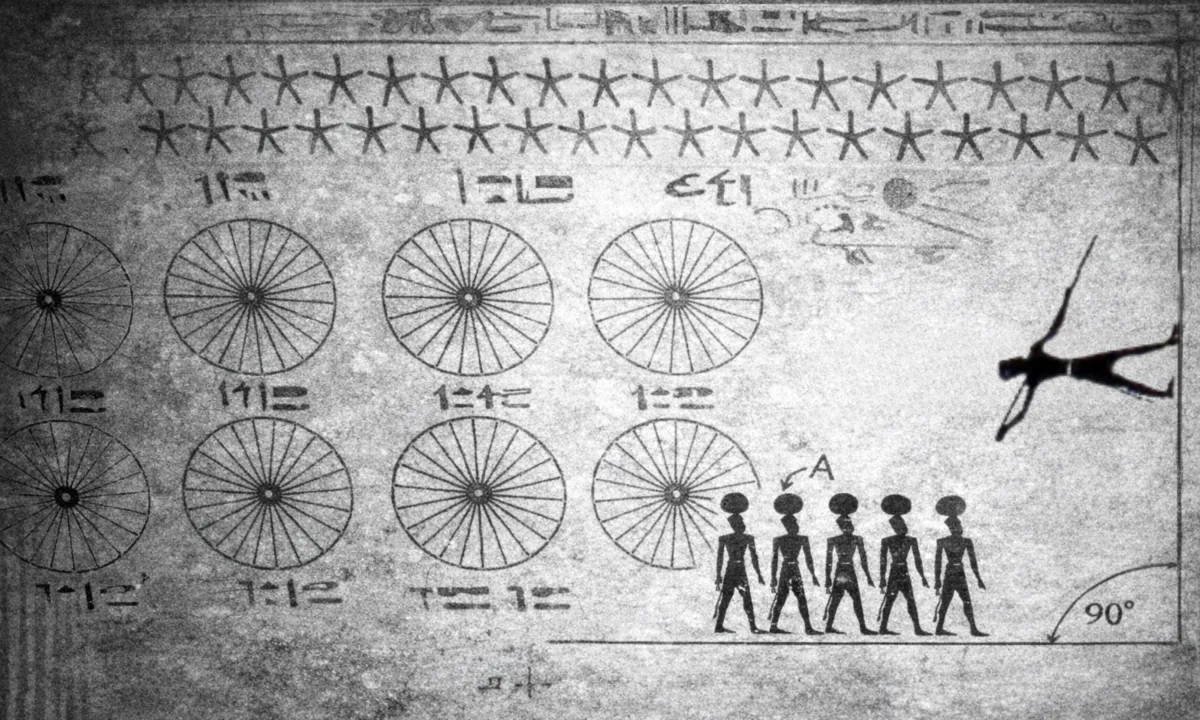
The illustration was created based on materials from the book The Ancient Secret of the Flower of Life by Drunvalo Melchizedek.
Living in everyday reality, we move linearly.
In time, in narrative, in our personal story: “I experience,” in the continuity of events.
We think in terms of cause and effect, past and future, a path that must be walked.
A portal does not appear after movement has stopped.
A portal appears in order to stop that movement.
It is a response of the matrix to the moment in which consciousness continues to move in the same direction, even though that direction no longer leads to recognition. A portal is not the result of stopping, but the mechanism that initiates it.
On your personal timeline, a portal is inscribed in the structure of your individual birth matrix. It activates at points where further linear movement reinforces illusion instead of dissolving it.
A portal interrupts continuity. It stops the narrative.
It disrupts automatic movement along the timeline, history, and identity.
It does not appear when you decide to stop.
Stopping is not a goal, a reward, or a punishment.
It is a natural threshold moment in which further movement in the same direction is no longer possible.
It does not lead to another place.
Through it, you stop moving in the same way and open a space for a change in the orientation of consciousness.

Eckhart Tolle, in A New Earth, describes the same moment of stillness from the perspective of consciousness. He writes that true change does not happen by adding anything to oneself, but by ceasing identification with the movement of the mind.
“The moment you realize that you are not your mind is the beginning of true awakening.”
Eckhart Tolle
Eckhart Tolle
Life is filled with such moments, subtle cracks, barely perceptible on the surface of experience, serving as portals through which we move from linear time into eternity.
As Rupert Spira writes in You Are the Happiness You Seek, these are moments in which the linear narrative briefly loosens its grip, and we stop following thought, story, and future-oriented purpose.
This is not an escape from experience, but a return to something that has always been present. After a while, the content of experience veils this space again, yet a trace remains, and within us arises a longing not for the past, but for that which is only temporarily obscured.
In these moments, striving against reality gives way to being.
Movement comes to rest, and presence becomes self-evident.
For Eckhart Tolle, stillness is essential, too. Not as a technique, but as a natural moment in which identification with thoughts, history, and form comes to an end. It is in this pause that presence appears.
“Presence arises the moment the unconscious stream of thinking comes to an end.”
Eckhart Tolle
Eckhart Tolle
LOOPortals point to such moments.
Moments that do not happen in the future.
They are not the goal of a journey.
They appear when the need for further movement disappears.
Melchizedek, Tolle and Spira speak of the same thing, using different languages.
Melchizedek describes it through the structure of existence, Tolle and Spira through the experience of consciousness and presence.
Both point to the same point. A stopping in which you cease to follow what is known.
This is not a transition to another world.
It is a recognition of what has always been present, yet invisible from the level of linear movement.
„Self-enquiry is not a journey towards a discovery; it is a discovery of the journey’s starting point.
You are already that for which you are searching.”
Rupert Spira
Rupert Spira
Adoration of the Rising Sun – from the Papyrus of Ani (Book of the Dead), dated to the 18th Dynasty (approx. 1250 BCE).
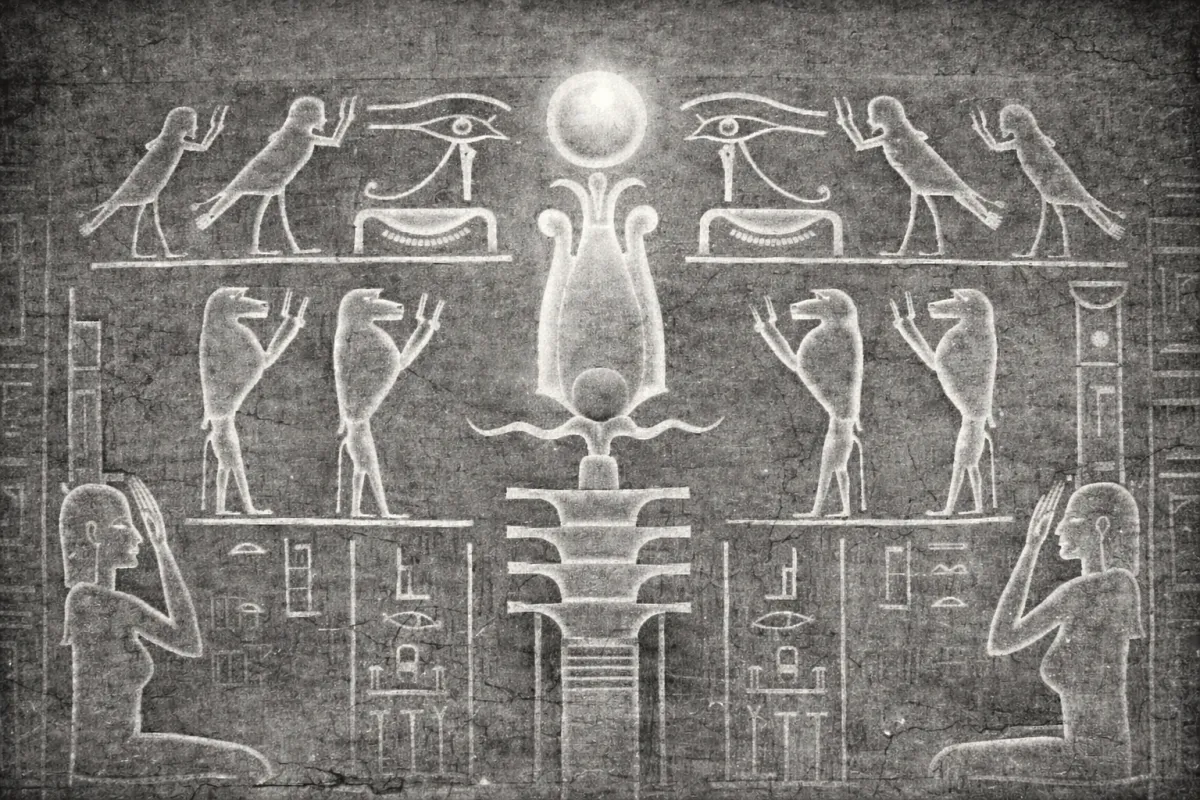
Even in ancient Egypt, through sacred symbols, the process of the development of consciousness and the recognition of the Self was depicted.
This illustration is not a decoration. It is a schematic for transcending dualism.
The Djed pillar at the center symbolizes the cessation of linear movement and a return to the axis.
It is the "I Am" moment, in which you stop replicating old patterns and energy returns to its vertical alignment.
The Lotus growing from the pillar does not signify an escape upwards. It signifies an opening that becomes possible only when the axis is stable.
It is a shift in the direction of perception, not a transition "somewhere else."
The Golden Disk – the Sun at the summit – symbolizes the Source.
When the unconscious momentum of the mind ceases, that which has always been present becomes visible.
The figures surrounding the scene indicate mindful presence. Consciousness stops identifying with the movement of thoughts and remains in stability.
This can be called the Ancient Portal of Stabilization. A moment of returning to the axis. Not to achieve something, but to recognize.
LOOPortals point to precisely such moments of stillness.
This is ancient knowledge translated into modern language to help you recognize that which is unchanging within you.
A portal is therefore neither a construct nor an idea.
It is not a symbol nor a metaphor.
It is a real moment in which the structure of reality enables an exit from the illusion of continuous becoming.
It is a point at which you stop moving forward in time and begin to perceive beyond narrative, beyond history, beyond movement.
This is not a passage “somewhere.”
This is recognition.
And this is what LOOPortals are about.